GARDENS IN JAMMU & KASHMIR
Nishat Garden
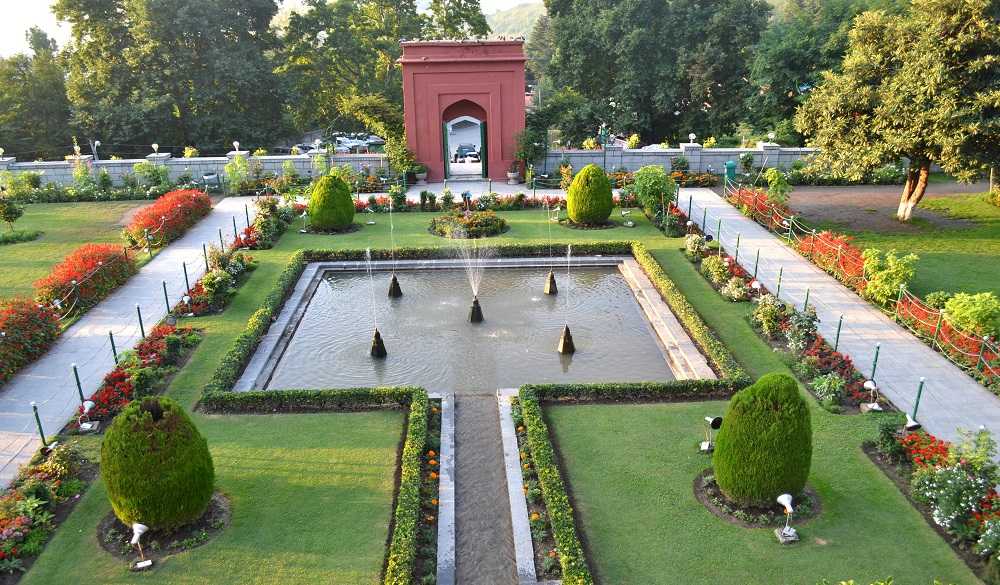
Nishat Bagh is located on the banks of the famous Dal Lake about ten kilometers from the Srinagar city center in the lap of Zabarwan mountains. This beautiful terraced garden commands a breathtakingly awesome view of the Dal Lake in all seasons with summers having charm of its own. Second largest Mughal garden after Shalimar Bagh in the Kashmir Valley, the garden was designed and built by Asif Khan, elder brother of Nur Jehan in 1633. The Nishat Bagh has an axial stream flow design, suitable for hill conditions with water source originating at the top of the hill. N ishat Bagh has a rectangular layout with east-west length of 548 metres and width of 338 metres.
Starting from the shores of Dal Lake, Nishat Bagh has twelve 12 terraces representing twelve Zodiacal signs. However, the lower terrace no longer exists now, having been cut off by the modern road. The garden, thus, consists of only nine terraces at present. It has two sections; the public garden and the private garden. The central canal, running through the garden, is 4 metres wide and has a water depth of 20 centimetres. Some old Mughal period buildings dot the outskirts of the garden, reminding one of the builders of this famous picnic spot and tourist attraction.
This garden has been centre of shooting of many Bollywood movies and has lent exquisite shots for film songs. For its lined Chinars, multi- hued flower beds and tranquil ambience, it has remained one of the most sought after locations in Kashmir ever since it was thrown open to the public by the Mughals. The place can be approached from Tourist Reception Centre by a local bus or one can hire a taxi that will drop at its gate in just 15 minutes. One more way of visiting the Bagh is through the Dal Lake using the famous water taxi of Kashmir, the Shikara. It is the most pleasant mode of transport for the tourists to reach here. A famous picnic spot, Nishat Bagh also offers shopping facilities to its visitors as there are a number of shopping stalls situated opposite the garden.
Shalimar Garden
Shalimar Bagh, the pinnacle of the Mughal horticulture in Kashmir, is 15 kms from the Srinagar city centre located majestically on the right bank of Dal Lake. The garden with sweeping vistas and artfully laid out terraces was built by Mughal emperor Jehangir for his wife Nur Jehan in 1619. Measuring 587 m by 251 m, Shalimar garden has four terraces, one above the other. Like equally famous Nishat Bagh, a canal lined with polished stones runs through the middle of the garden, consigning it a mesmerizing beauty.</p><p> Zafar Khan, the governor of Kashmir during Shah Jahan’s reign, extended Shalimar Bagh and named it Faiz Baksh or the bountiful. Electrification of the premises was done during Hari Singh’s rule. So, the garden was extended and improved by many rulers and called by different names, however, Shalimar Bagh remained in vogue till date.
This garden is the largest Mughal garden in Kashmir and Shalimar Bagh was Jehangir’s imperial summer residence and the Royal Court for 13 years. The garden is well known for Chini Khanas, or arched niches, behind garden waterfalls. These niches were lighted at night with oil lamps, giving a fairy tale appearance to the water falls. However, now the niches hold flower pots that reflect their colours behind the cascading water.
Shalimar Bagh was well maintained by all the rulers of Kashmir and continues to be so even now for being one of the prominent tourist attractions around the Dal Lake. The garden presents a beautiful spectacle during the autumn when the colour of the leaves of the famed Chinar trees turns red. With lush green Zabarwan in its background, the redness of the Chinars mesmerize one and all who happen to cast t heir eyes on the scene. The garden was the inspiration for other gardens of the same name, notably the Shalimar Bagh in Delhi (built in 1653) and Shalimar Gardens in Lahore, Pakistan built by Emperor Shah Jahan in 1641.

Harwan Garden
In the outskirts of Srinagar city, about 18.7 kilometers south, lies the Harwan village which is located on the hillside. This place is famous for some remarkable remains of ancient ornamented tile pavements of the Buddhist era. It is believed that the fourth Buddhist council was held here under the patronage of Kaniska. The proceedings of the council are said to have been scribbled on copper plates and buried somewhere in the premises of the Buddhist temple. The archeological remains include the ornamental tiles that depict the dresses of the people of that time, such as loose trousers, Turkoman caps or close fitting turbans and large ear-rings. The findings here have the central Asian influence.
There is a garden at Harwan as well. This beautiful and massive garden is located in the foothills of Zabarwan mountain and the snow- capped peaks beyond. It has become a popular picnic spot for the locals and for the tourists from the outside state, it is a must visit in Srinagar. Behind the Harwan garden just near the Dachigam National Park lies a beautiful but small lake which sends out a canal through the center of Harwan garden. The canal is bordered with blossoming flowerbeds and chinar trees. Harwan Garden lacks the usual terraces, artificial fountains etc, like the other gardens of Kashmir.
It has been deliberately kept devoid of these man-made things as the main attraction of the Harwan garden, is its natural beauty that is present in plenty. The huge verdant lawns attract locals and the tourists to this place who enjoy its serene environs. Harwan is an ideal place to take long walks in the lap of nature.
BadamWari
The early bloom of flowers on Almond trees in the sprawling historic Badamwari garden in Shahr-e-Khaas has become a source of attraction for nature lovers and tourists, alike. Situated on foothills of Hari Parbat, the 300 kanals garden was dotted with trees, flowers and cascades providing a soothing experience to the visitors.
Historians maintain there was no record to suggest who laid the garden but they say it existed even before the rule of Sultan Zain-ul-Abidin in the 14th century. A well covered dome in the garden is named after an Afghan ruler, Warris Khan. The bloom on the Almond trees heralded the spring and marked the New Year for Kashmiris. But with the passage of time, particularly during the past three decades, it has lost its glory. As part of its Corporate Social Responsibility and Heritage Trust, the garden was revived by the JK Bank and formally thrown open for public in 2008.
This garden is nowadays visited by a large number of nature lovers and visitors. The Badamwari Garden is in full bloom during the spring season. The aura of the garden has fragrant airs and beautiful white flowers. You will spend a wonderful time at the Badamwari garden. You can stroll along the walkways and watch the beautiful flowers. An evening at the garden is really refreshing. You will feel awesome enjoying the scenic beauty of the garden. You will find flocks of tourists at the garden who come to watch the splendid garden.
PariMahal
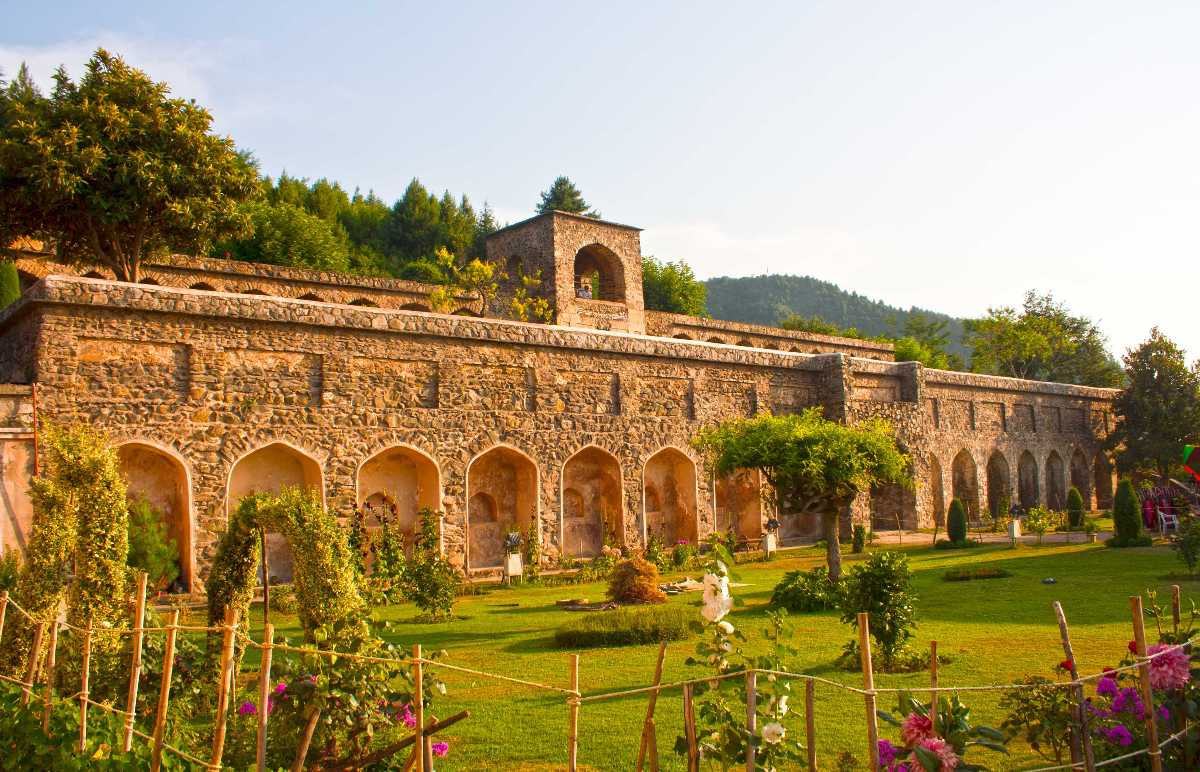
Pari Mahal or the abode of fairies sits majestically upon the slopes of Zabarwan mountain range west of Chashma Shahi, around 13.2Km from the Srinagar city centre. It is a garden palace and its construction in mid- 1600s is ascribed to Dara Shikoh, the son of Mughal emperor Shah Jahan, who used to study astrology and astronomy here. Prince Dara had a great interest in mysticism and he got the garden built for his Sufi tutor, Mullah Shah Badakhshi. Like other gardens, it has attracted a huge number of tourists over the years for its mysterious yet tranquil ambience. However, unlike other Mughal gardens, it has no water cascades but used to have fountains fed through pipes the tanks made for that purpose.
Pari Mahal boasts of a unique architecture not found anywhere in the Valley of Kashmir and clearly depicts the immense patronage of art by the Mughal emperor Shah Jahan. It consists of six terraces aligned roughly north-south, with the uppermost point at its southern end and arched retaining walls supporting the terraces against the mountain. The garden measures 122 meters by 62.5 meters.
Pari Mahal can be approached by a road that ends just at the main entrance of the garden. It is a ladder- shaped structure with six terraces. The terraces are accessed via sets of steps on their corners. Each flight of steps measures 6.7 m by 1.3 m. At the center of the sixth, or uppermost, terrace, a water tank with an arched wall is set against the mountain slope. From the sixth terrace, a baradari or pavilion overlooks the lower terraces. After remaining in a state of ruin for many years, the garden has been thrown open for the visitors after minor renovations. Visible from far away, the structure looks especially intriguing when flood lights are switched on at night. As it falls on way to other Mughal gardens, it is a must- visit place when you are in Srinagar.
Tulip Garden
INDIRA GANDHI MEMORIAL TULIP GARDEN in Kashmir is Asia's largest tulips garden. The tulip garden, formerly known as Siraj Bagh , is located at the foothills of Zabarwan mountains and on the banks of Dal lake. The major attraction here is the large variety of Tulips found in thousands of numbers. There are over 60 varieties of early, mid and late blooming tulips. Department of Tourism organises “Tulip festival ”every year.
Tulip festival is an annual celebration that aims to showcase the range of flowers in the garden as a part of tourism efforts by the Government of Jammu and Kashmir. Tulip, which has its origin in Persia (Iran), was introduced in Europe in 17th century, where it had been developed in different varieties. Holland is the largest producer of tulips, which inhabits the mountain areas extending from Europe to Central Asia. The plantation of tulips begins from September, before the start of winter season and the garden is in full bloom by mid-April. The sight is heavenly during the full bloom season with all shades of the rainbow scattered on the fields of this garden. . This garden is the most spacious one in Srinagar as compared to the other Mughal Gardens.
Chashma Shahi or the Royal Spring dots the slanting slopes of the Zabarwan Range, near Rajbhawan (Governor‘s house) in the outskirts of Srinagar at a distance of nine kilometers from the city centre. It is the smallest yet the more enchanting of the Mughal gardens of Srinagar perched half way on the Dal side of the hillock overlooking the vast lake below and the snow- capped Himalayan mountain peaks far away. Built around a spring, the garden was laid by Mughal emperor Shah Jahan in 1632 A.D. the spring is famous for pure, cool and sparking waters having digestive and curative properties. Famous writer Aldous Huxley says that Chashma Shahi is "architecturally the most charming of the gardens near Srinagar".
Measuring 108 metres by 38 metres and spread over one acre of land, Chashma Shahi has three terraces, an aqueduct, waterfalls and fountains. It is built in such a way that the spring water is the source of fountains and from there, water flows along the floor of the pavilion and cascades to a lower terrace along a polished black stone chute. The artistically build garden has Persian influence in its design and the main focus is on the spring, the water of which flows through its centre in terraces, giving it a serene and enlivening look.
The visitors approach the uphill garden through a flight of stairs running up along the terraces to the spring. Its water has been so darling to the Mughal emperors that it used to be taken all the way from Srinagar to Agra during Shah Jahan’s reign. Jawahar Lal Nehru also used to get the water of the spring to Delhi. The garden is connected by the Boulevard Road which passes along the banks of the Dal lake. There are many hotels and restaurants available for boarding and lodging near the garden.

Botanical Garden
A Botanical Garden was set up at Srinagar in 1969 in memory of Jawaharlal Nehru. Famous as Jawaharlal Nehru memorial Botanical Garden, this is a vast and beautiful garden. It encompasses unique varieties of plants, trees and voluminous varieties of flowers such as from Himalayan Orchids. This garden is on the mountains banks and fully covered with flowers and green shrubs. Spread over an area of approximately 80 hectares, and is situated on the banks of Zabarwan mountain slopes near Dal Lake and along a road that goes to Mughal Garden, Chashme Shahi. Jawaharlal Nehru Botanical Garden is divided into four components by the name of sporting garden, research section garden, botanical garden and centre of plant introduction. It also consists of several mini gardens. In this garden one can feel the beauty and blessing of nature. About Jawaharlal Nehru Memorial Botanical Garden Jawaharlal Nehru Memorial Botanical Garden was set up in 1969 and it was fully established in 1987. This garden has a dense temperate forest of Oak trees. This garden has a collection of well nursed and well maintained temperature trees and plants. It has a variety of different trees species of more than 50 breeds along with a wide range of plants and flowers. A greenhouse lies in the middle of the garden where you will be able to spot different types of Orchids. The botanical garden is home to more 1.5 lakh ornamental plants. Compared to Mughal Garden, this one is quiet and peaceful and it has a treasure of more than 300 breeds of Flora which includes cedar trees and willow trees. This is a well designed modern landscaped garden. Some hidden areas of garden have sidewalks made up of concrete along the side of the garden to encourage a stress free walk to nature lovers. There is a stunning lake here that spreads over 17 hectares. There are paddle boats in the lake that help visitors enjoy the beauty of this lake and garden. This garden has a beautiful lake and it provides sights of a pleasurable water garden and charismatic waterfalls. For the pleasure of children, there is a small field with merry-go-round, swings and see-saw games. This garden is a best place devoted to plant lovers and nature lovers.
Entry Fees
Entry fee to the Botanical Garden for adults i.e. above 12 years is Rs.10/- and for children below 12 years of age is Rs.5/-. To avail the facilities of boating there are extra charges.
How to Reach
By Air:-
Srinagar's domestic airport is connected to some of the important cities of India. It gets flights from Calcuta,Chennai, Delhi, Chandigarh and Mumbai. International visitors can take a flight from Delhi to reach Srinagar. From Srinagar Airport, one can take a taxi to reach Jawaharlal Nehru Memorial Botanical Garden.
By Rail:-
Jammu railway station is closest to Srinagar (290 km). It receives trains from Delhi, Chennai, Bangalore and Trivandrum. After arriving at Srinagar, one can hire a taxi to reach Botanical garden.
By Bus:-
There are innumerable bus service providers offering luxurious bus package tours to Botanical garden. There are also state-owned buses and taxis available for commute. However, make sure to check the bus timings prior to starting your journey to the Jawaharlal Nehru Memorial Botanical Garden.
Best Time to Visit
Botanical garden is easily approachable from Srinagar. The best time to visit this beautiful garden is during summers as climate is favorable for outdoor activities in summers such as walking and boating. The best months to visit this place is throughout The Year
Timings:-
The Jawaharlal Nehru Memorial Botanical Garden remains opens from 9:00 am to 7:00 pm.


Comments
Post a Comment